Hybrid and Electric Vehicle Collision Repair: What Changes When There’s a High-Voltage Battery
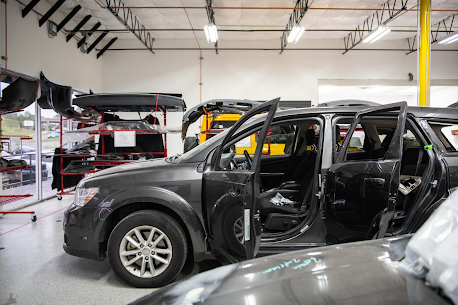
Hybrids and electric vehicles are repaired with the same body and paint skills as any car, plus a layer that does not exist on a gasoline vehicle: a high-voltage battery and the systems around it. Before a technician touches a damaged EV, the high-voltage system is assessed and, when required, de-energized; before the vehicle is returned, the battery and its enclosure are confirmed undamaged. Silver Lining Collision follows the manufacturer’s procedures for each vehicle, and here is what owners should know.
First: is the vehicle safe?
A collision can damage the high-voltage battery, its cooling system or its cabling without obvious signs. Manufacturers publish inspection procedures that start at intake: scanning for high-voltage fault codes, checking isolation, inspecting the battery enclosure and underbody, and looking for coolant leaks from the battery loop. A vehicle with suspected battery damage is kept in a designated area away from the building until it is cleared, because a damaged lithium battery can heat and ignite hours or days after an impact.
De-powering
Many repairs near high-voltage components require the system to be disabled using the manufacturer’s procedure, which may include pulling a service disconnect and waiting a specified time for capacitors to discharge. Technicians trained on high-voltage systems perform this with the appropriate protective equipment. Welding, heat and even some pulling operations near the battery have specific rules.
Underbody damage matters more
On an EV the battery pack typically forms the floor. Curb strikes, road debris, a jack in the wrong place, or a low-speed impact that would be cosmetic on a conventional car can damage the pack’s enclosure or mounting. Manufacturers specify when a scraped or dented pack must be inspected or replaced, and a repair shop cannot simply paint over it.
Structural differences
EV structures are built around the battery, with reinforced sills and floor sections, often in high-strength steel or aluminum. Repair procedures define what can be sectioned and how. Some manufacturers restrict structural repairs to certified facilities with the right equipment and training.
Thermal management and cooling
Battery coolant loops run through the vehicle; damaged lines or radiators are part of many front-end repairs. The system must be properly refilled and bled per procedure.
Scanning and calibration
EVs are heavy on driver-assistance systems and sensors, so pre- and post-repair scans and calibrations are a given. High-voltage system checks are part of the post-repair scan.
Charging and towing precautions
A damaged EV should not be charged until the battery is inspected. Flatbed towing is standard; many EVs cannot be towed with drive wheels on the ground. If the vehicle is at a storage lot after a crash, tell the lot and the tow operator it is an EV.
Parts and timelines
Battery-related and structural EV parts can carry long lead times, and some are restricted to certified repairers. Expect the estimate to flag them and the timeline to depend on them.
Insurance and total losses
Because battery inspection and replacement are expensive, EVs are totaled at a higher rate for a given level of visible damage. A thorough estimate, including the battery assessment, gives the insurer and the owner real numbers for that decision.
Questions to ask a shop
- Are your technicians trained on high-voltage systems?
- Do you follow the manufacturer’s EV collision procedures, including battery inspection?
- Where will the vehicle be stored if the battery is suspect?
- Will the vehicle be scanned and calibrated after repair?
Repairs that respect the battery
Silver Lining Collision repairs hybrids and EVs at our Dallas, Arlington, Fort Worth and Houston shops following manufacturer procedures, with scanning and calibration included. Call Dallas (214) 242-8727, Arlington (817) 618-2705, Fort Worth (817) 615-9575 or Houston (832) 991-8979, or contact us.

