Pre- and Post-Repair Scans: What They Find That Eyes Can’t
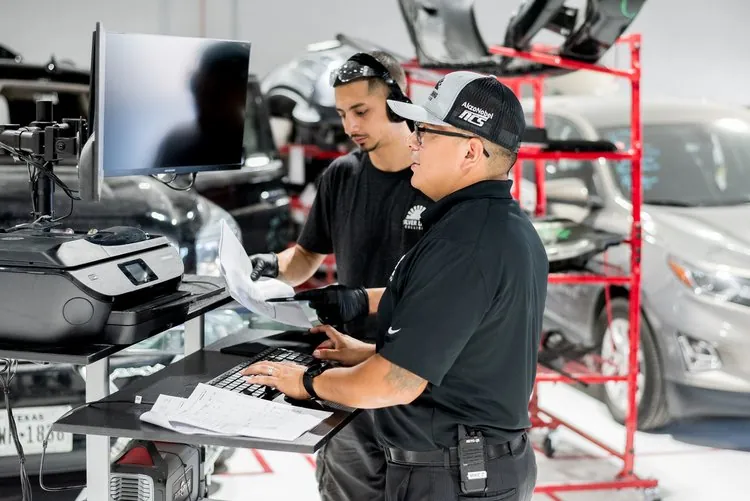
A late-model vehicle has dozens of computers, and a collision disturbs many of them: sensors knocked out of position, connectors unplugged, modules that logged a crash event, airbag systems that set faults. None of that shows up as a dent, and much of it never lights a dashboard warning. A pre-repair diagnostic scan finds it before the estimate is finished; a post-repair scan proves it is cleared before the vehicle goes home. Silver Lining Collision scans vehicles at both ends of every repair, and here is what the scans catch.
What a pre-repair scan does
A scan tool connects to the vehicle’s diagnostic port and queries every module: engine, transmission, body control, airbag, anti-lock brakes, steering, and the driver-assistance systems (cameras, radar, parking sensors, blind-spot monitors). It reports stored fault codes and the status of each system. On a collision-damaged vehicle the pre-scan typically finds:
- Faults in sensors behind the damaged area: a parking sensor in a bumper, a radar unit behind the grille, a side-impact sensor in a door.
- Airbag and seat belt pretensioner codes, including deployments and faults that require component replacement.
- Communication errors from unplugged or damaged connectors and harnesses.
- Pre-existing issues unrelated to the crash, which the scan documents so they are not confused with collision damage.
Everything found goes into the estimate with documentation, which is what gets it approved.
Why eyes miss it
Sensors and modules are hidden behind trim and bumper covers, and a sensor can be knocked out of alignment or cracked without any external sign. Many systems do not warn the driver about a stored fault; they simply operate degraded or not at all. A blind-spot system that stopped working after a rear-end hit will not announce itself until it fails to warn you.
What a post-repair scan does
After the repair is complete and the vehicle is reassembled, the scan is run again to confirm every fault is cleared, every module communicates, and no new codes appeared during the repair. If a system needs calibration, the scan shows it, and the calibration is performed and verified. The post-scan report is part of your repair file.
Scans and calibration are different steps
A scan reads the vehicle’s status. A calibration physically realigns a camera or radar to the manufacturer’s specification using targets and procedures. A scan after a bumper replacement will often show that the radar needs calibration; the calibration is then performed and the scan confirms it. Our vehicle calibration service covers both.
When manufacturers require it
Most manufacturers now publish position statements requiring pre- and post-repair scans on their vehicles after a collision, regardless of whether a warning light is on. Following those statements is part of repairing to manufacturer procedures, and it is why certified collision repair centers perform them on every job.
Do insurers pay for scans?
Yes, when documented as a required procedure. Scans appear as line items on the estimate or supplement with the manufacturer’s position statement attached. Approval is routine with most carriers.
What you receive
The pre-scan and post-scan reports, showing the codes found at intake and the clean result at delivery, are part of your repair documentation along with the photos and invoices.
What happens without them
A vehicle delivered without a post-repair scan may have safety systems that look fine and do not work: no blind-spot warning, no automatic braking, an airbag system with a fault. Those failures surface at the worst time. Scanning is cheap insurance against them.
Repairs that include the electronics
Silver Lining Collision scans and calibrates at all four Texas locations, with manufacturer-specific equipment. Call Dallas (214) 242-8727, Arlington (817) 618-2705, Fort Worth (817) 615-9575 or Houston (832) 991-8979, or contact us online.

